You want dental implants that fit better, heal faster, and feel more natural. 3D printing and guided implant surgery are changing how dentists plan and place implants. Instead of guessing angles and positions during surgery, your dentist can now plan every detail before you sit in the chair.
3D printing and guided surgery let you receive dental implants that are more precise, more personalized, and planned around your exact anatomy.
Digital scans and 3D imaging create a clear map of your mouth. From that map, your dentist can print custom surgical guides and, in some cases, design implant parts that match your unique needs.
This new approach gives you a more controlled procedure and often a smoother recovery. As technology improves, you can expect even more tailored solutions that focus on safety, accuracy, and long-term results.
Key Takeaways
- Digital planning allows your dentist to design implant treatment around your exact anatomy.
- 3D printing supports custom guides and parts that improve placement accuracy.
- Guided surgery increases control and supports better long-term implant outcomes.
The Evolution of Dental Implants
Dental implants have changed from manual, freehand procedures to precise, computer-guided treatments. You now benefit from stronger materials, better imaging, and tools that improve fit, function, and healing.
From Conventional Methods to Digital Transformation
In the past, dentists placed dental implants using two-dimensional X-rays and manual measurements. You relied on the clinician’s skill and visual judgment during surgery. This approach worked, but it left more room for placement errors.
Today, digital tools guide nearly every step. Dentists use CBCT scans and intraoral scanners to build detailed 3D models of your jaw. These models support digital planning and guided surgery, which can improve accuracy compared to freehand methods.
3D printing now plays a key role. Many clinics print custom surgical guides from light-curing polymers to control implant angle and depth. This process helps you receive implants that match your anatomy more closely.
Milestones in Implant Material Advancements
Material science has shaped modern dental implantology. Early implants varied in design and success rates. The widespread use of titanium implants marked a major turning point.
Titanium dental implants support strong osseointegration, which means your bone bonds directly to the implant surface. Titanium offers high biocompatibility, strength, and corrosion resistance. These traits help your implant stay stable under chewing forces.
More recently, zirconia implants have gained attention. Zirconia is a ceramic material with good biocompatibility and a tooth-colored appearance. Some patients prefer it for aesthetic reasons, especially in visible areas.
Researchers now explore custom 3D-printed titanium and other materials tailored to your anatomy. These advances aim to improve fit, healing, and long-term performance while keeping treatment predictable and safe.
Digital Workflow and 3D Imaging in Implant Dentistry
You plan implants today with precise digital tools, not guesswork. You gather 3D data, map bone and anatomy with CBCT scans, and design restorations with CAD/CAM systems that guide both surgery and lab work.
Intraoral Scanning and Data Acquisition
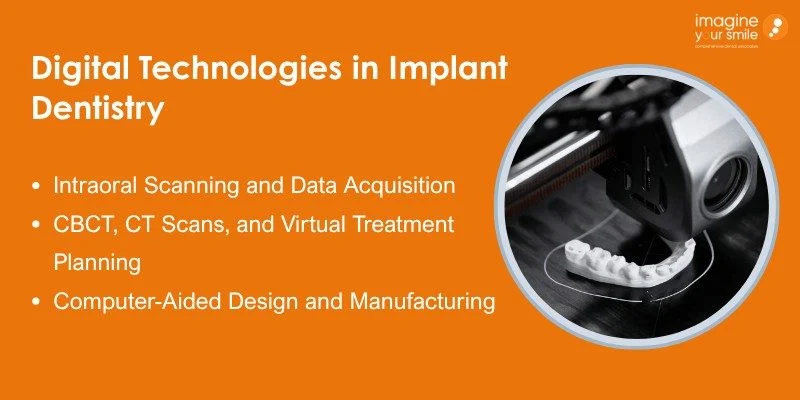
You start your digital workflow with an intraoral scanner. This device captures detailed 3D images of your teeth and gums in minutes.
You no longer rely only on traditional impression trays and material. Instead, you create accurate intraoral impressions as digital files that you can store, send, and review on screen.
Intraoral scanning helps you:
- Record soft tissue shape around implant sites
- Capture the position of existing teeth
- Check bite alignment in real time
- Rescan small areas without repeating the full impression
Digital files reduce distortion that can happen with physical materials. You also improve patient comfort because you avoid bulky trays.
When you combine intraoral scanning with CBCT data, you build a complete 3D model of bone and soft tissue. This step forms the base of your virtual and advanced dental treatment planning and surgical guide design.
CBCT, CT Scans, and Virtual Treatment Planning
You use cone-beam computed tomography (CBCT) to see what you cannot see in the mouth. CBCT scans show bone height, width, and density in three dimensions.
Unlike a traditional 2D X-ray, a CT scan or CBCT gives you cross-sectional views. You can measure the exact distance to the nerve canal or sinus before you place an implant.
With 3D imaging, you can:
- Evaluate bone volume at the planned site
- Identify vital structures such as nerves and sinuses
- Assess bone quality for primary stability
- Plan angulation and depth before surgery
You import CBCT scans and intraoral scanner data into planning software. This process creates a virtual patient model.
From there, you perform virtual treatment planning. You position implants on screen based on bone anatomy and final crown shape, not just available space. This approach supports safer and more predictable guided surgery.
Computer-Aided Design and Manufacturing
After planning, you move into computer-aided design (CAD). In this stage, you design surgical guides, custom abutments, and final restorations using digital software.
CAD allows you to control:
- Implant angulation
- Emergence profile
- Margin placement
- Contact points with nearby teeth
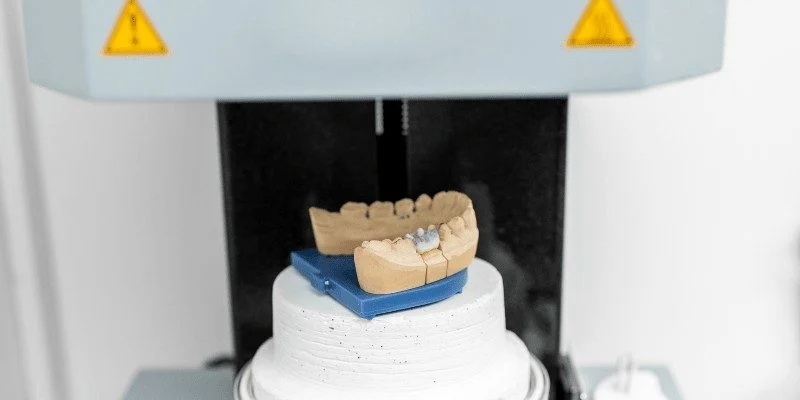
You then send the design to computer-aided manufacturing (CAM) systems. CAM uses milling machines or 3D printing to produce the guide or prosthetic with high precision.
CAD/CAM systems reduce human error because machines follow the exact digital plan. You also shorten turnaround time between surgery and final restoration.
When you connect intraoral scanning, CBCT, CAD, and CAM into one digital workflow, you create a coordinated system. Each step builds on accurate data, which supports precise implant placement and well-fitting restorations.
3D Printing Technologies for Dental Implants
You now see 3D printing, also called additive manufacturing or three-dimensional printing, at the center of modern implant dentistry. These systems build objects layer by layer from a digital file, which gives you tight control over shape, fit, and surface detail.
Overview of Additive Manufacturing Techniques
Additive manufacturing creates parts by adding material in thin layers instead of cutting material away. You start with a digital 3D model from a scan or design software, then send that file to a printer.
In implant dentistry, you use this method for surgical guides, custom abutments, temporary crowns, and even metal implant parts. The layer-by-layer process supports rapid prototyping, so you can test and adjust designs before final placement.
A review of 3D printing in implant dentistry explains how these systems support both the surgical stage and the prosthetic stage of treatment. You can print guides for precise drilling and also print restorations that attach to implants.
The main benefit for you is control. You match the design to the patient’s anatomy instead of adapting the patient to a standard part.
SLA, SLS, FDM, and DMLS in Dentistry
Different printers use different energy sources and materials. Each method fits a specific dental task.
Stereolithography (SLA) uses a laser to cure liquid resin into solid layers. You often choose SLA for surgical guides because it delivers high detail and smooth surfaces.
Selective laser sintering (SLS) and selective laser melting (SLM) use lasers to fuse powdered materials. These systems can produce strong parts, including metal components, with complex shapes.
Fused deposition modeling (FDM) pushes melted plastic, such as PLA (polylactic acid) or ABS, through a nozzle. FDM costs less, but it usually offers lower detail. You may use it for study models or basic prototypes.
Direct metal laser sintering (DMLS) builds metal parts layer by layer using powdered titanium or similar alloys.
Material Choices and Printing Parameters
Material choice affects strength, fit, and long-term stability. For surgical guides, you often use biocompatible resins designed for SLA printers.
For metal implants and custom abutments, you rely on titanium powders in DMLS or SLM systems. These metals support bone integration and handle chewing forces.
FDM printers use thermoplastics like PLA (polylactic acid), ABS, and sometimes polycaprolactone. PLA prints easily and suits models, but it lacks the strength needed for permanent implant parts.
You must also control key 3D printing parameters, such as:
- Layer thickness
- Print speed
- Laser power
- Build orientation
- Post-processing steps
Small changes in these settings affect surface roughness, accuracy, and mechanical strength. When you adjust parameters with care, you improve fit and reduce the need for chairside corrections.
Guided Implant Surgery and Surgical Planning
You use digital imaging and software to plan implant position before you enter the operatory. This process connects 3D scans, surgical simulation, and printed guides to help you control angulation, depth, and spacing.
3D-Printed Surgical Guides and Osteotomy Templates
You start with a CBCT scan and often an intraoral scan. The software lets you place virtual implants based on bone volume, nerve position, and the final prosthetic plan.
Guided implant surgery uses this data to create 3D-printed surgical guides. These guides fit over teeth, bone, or soft tissue and control your drill path during the osteotomy.
Many clinicians now rely on 3D printed surgical guides for precise implant planning and execution to reduce guesswork. The guide sleeves help you maintain the planned depth and angulation.
In more complex cases, you may also use osteotomy guides or cutting guides. In oral and maxillofacial surgery (OMFS), similar guide systems support jaw reconstruction and maxillofacial reconstruction by transferring the digital plan directly to the surgical field.
Accuracy, Safety, and Clinical Workflows

When you use guided implant surgery, you follow a structured digital workflow. This often includes CBCT imaging, virtual implant placement, and guide fabrication.
Digital planning tools support safer placement near vital structures. A review of guided dental implant surgery and survival outcomes reports high survival rates, with many failures linked to early lack of osseointegration rather than guide use.
You still need clinical judgment. Limited mouth opening, poor guide fit, or patient movement can affect accuracy.
Modern workflows may combine intraoral scanners, in-office CBCT, planning software, and even chairside printing. Many practices adopt a contemporary workflow for guided implant surgery to improve coordination between surgical planning and prosthetic design.
Applications in Maxillofacial and Orthognathic Surgery
You can extend guided planning beyond single implants. In oral and maxillofacial surgery, digital planning supports jaw reconstruction, trauma repair, and tumor-related defects.
For maxillofacial reconstruction, you may design patient-specific cutting guides and reconstruction plates. These guides transfer your surgical simulation directly to bone segments.
In orthognathic surgery, you often use virtual planning with occlusal splints to control jaw position. Guided systems help you plan osteotomies and reposition the maxilla or mandible with more predictable alignment.
You apply the same core steps: scan, simulate, print, and execute. Whether you place implants or correct jaw deformities, guided surgical planning helps you move from a digital plan to precise action in the operating room.
Personalized and Next-Generation 3D-Printed Implants
Digital planning and additive manufacturing now let you receive implants that match your anatomy, use advanced biomaterials, and include surface features that support healing and reduce infection risk.
Patient-Specific and Customized Solutions

You no longer need to rely only on standard implant sizes. Dentists can design patient-specific implants using CBCT scans and intraoral scans to capture your exact bone shape and volume.
Software then creates a digital model that guides the production of 3d-printed dental implants and surgical guides.
This digital workflow supports precise production that matches human anatomy. Labs often print custom implants in titanium or zirconia based on your clinical needs.
You benefit in several ways:
- Better fit in areas with limited bone
- Fewer adjustments during surgery
- Improved alignment with guided surgery systems
These customized dental implants can also support implant-supported crowns or bridges designed at the same time. This integrated process reduces guesswork and gives you a treatment plan built around your anatomy, not a stock component.
Innovative Materials and Surface Modifications
Material choice directly affects how your implant performs over time. Many 3d printed dental implants use titanium alloys such as Ti-6Al-4V, which offer high strength and proven biocompatibility.
Other biocompatible materials include zirconia and certain high-performance polymers. Each option balances strength, esthetics, and tissue response.
Additive manufacturing also allows control over surface texture. Instead of a smooth surface, engineers can print micro-rough or porous structures that support bone attachment.
You should know that surface design matters as much as the base material. A well-designed surface can:
- Increase bone-to-implant contact
- Improve initial stability
- Support long-term function of implantable devices
These improvements focus on predictable healing, not cosmetic trends.
Bioactive and Antimicrobial Coatings
Surface coatings now go beyond simple roughness. Manufacturers apply bioactive coatings to encourage faster bone bonding around your implant.
Some coatings release calcium or phosphate ions that support bone growth. Others aim to reduce inflammation at the surgical site.
Clinicians also explore antimicrobial coatings to lower the risk of infection, especially during early healing. These coatings may include silver particles or other agents that limit bacterial growth on the implant surface.
Reviews on 3D printing in dental implantology note that surface engineering plays a growing role in implant success. You still need proper oral hygiene and follow-up care, but these technologies add another layer of protection.
By combining custom design, strong biomaterials, and targeted coatings, modern 3d-printed implants aim to improve fit, stability, and healing in a clear and measurable way.
Clinical Impact, Limitations, and Future Directions
3D printing and guided surgery change how you plan, place, and restore implants. They improve fit and stability, but they also raise new clinical, financial, and training demands.
Enhanced Osseointegration and Bone Regeneration
You want strong osseointegration because it drives long-term implant stability. Modern surface treatments and 3D-printed implant designs improve bone-to-implant contact by creating porous or textured surfaces that support cell attachment.
Research on 3D printing in implant dentistry shows how additive manufacturing supports both surgical and prosthodontic stages. You can design implants and guides that match the patient’s anatomy, which improves primary stability at placement.
Better primary stability reduces micromovement. That helps protect early healing and supports bone regeneration around the implant.
Keep in mind that success depends on more than design. You must control surgical technique, loading protocols, and post-curing steps for printed components to maintain accuracy and material strength.
Tissue Engineering, Growth Factors, and 4D Printing
You now see closer links between implant dentistry and tissue engineering. Researchers explore growth factors and scaffold materials that promote bone regeneration and vascularization around implants.
Some reviews on the future of dental implants highlight bioengineered and 3D-printed implants that support better tissue integration. These approaches aim to guide new bone formation directly at the implant surface.
Bioprinting pushes this idea further. You can print scaffolds seeded with cells or bioactive agents that support healing in complex defects. This supports personalized medicine, especially in large ridge defects or trauma cases.
4D printing adds time as a factor. Materials may change shape or stiffness in response to heat or moisture, which could improve adaptation and healing.
Still, many of these options remain in early clinical phases. You must weigh potential benefits against limited long-term data and strict regulatory controls.
Regulatory, Economic, and Educational Considerations
You face clear regulatory and cost barriers when you adopt 3D printing in dentistry. Equipment, materials, and maintenance require upfront investment, and material validation and post-curing protocols must meet safety standards.
Cost and material limits still slow wider use. You must also document accuracy, sterilization methods, and mechanical performance.
Education plays a major role. You can use 3D-printed anatomical models for medical education and patient education. These models help you explain implant position, guided surgery steps, and expected outcomes.
Training also improves surgical accuracy. When you practice on printed models, you refine drilling depth, angulation, and guide placement before you treat a patient.
As technology evolves, you will need ongoing training. Digital planning, guided surgery software, and personalized workflows require steady skill updates to protect patient safety and clinical outcomes.
Frequently Asked Questions
3D printing and guided surgery change how dentists plan and place implants. These tools improve fit, accuracy, healing time, and patient comfort.
How is 3D printing technology enhancing dental implant procedures?
3D printing lets your dentist create detailed models of your mouth before surgery. They use digital scans to design surgical guides and custom parts that match your exact bone shape.
Many clinics now use 3D printed surgical guides for dental implant procedures. These guides help your dentist place the implant at the right depth and angle.
Research also shows that 3D printing in implant dentistry supports both the surgical and final crown stages. This means better planning, fewer surprises, and a smoother process for you.
What are the latest advancements in guided surgery for dental implants?
Guided surgery now combines 3D scans with digital planning software. Your dentist maps out the exact implant position before you even sit in the chair for surgery.
With 3D planning for guided dental implant surgery, dentists use custom guides to improve placement accuracy. This reduces guesswork and protects nearby nerves and sinuses.
Some offices also offer same-day temporary teeth. You leave with a fixed tooth instead of waiting weeks for a replacement.
Can I benefit from 3D printed dental implants and what are their advantages?
You may benefit if you need a custom fit due to bone shape or space limits. 3D printing allows more precise design than many traditional methods.
According to research on AI and 3D printed customized dental implants, digital planning and printing improve precision and personalization. This can support better stability in the early healing stage.
You may also spend less time in the chair. Faster production and better planning often reduce extra visits.
What should patients expect from the future of dental implant surgery?
You can expect more digital steps before surgery begins. Dentists will rely more on scans, software, and printed guides instead of manual measurements alone.
Some clinics already print parts in-house, which shortens wait times. As 3D printing dental implants in the office becomes more common, you may see faster turnaround and more predictable results.
Future care will likely focus on comfort, shorter healing times, and better long-term fit.
How are dental schools like Tufts University influencing the future of implant technology?
Dental schools train future dentists in digital scanning, 3D design, and guided surgery. When schools invest in this training, new graduates enter practice ready to use advanced tools.
Universities also support research on materials and implant design. Their studies help test safety, strength, and long-term outcomes before new methods spread widely.
If you choose a dentist trained in modern programs, you are more likely to receive digitally planned care.
Are there any risks associated with 3D printed implants compared to traditional methods?
3D printed implants still require careful planning and skilled placement. Poor design or incorrect printing can affect fit.
Material quality also matters. Dentists must use approved, biocompatible materials to reduce the risk of infection or implant failure.
When trained professionals follow proper protocols, 3D printed tools and guides can be as safe as traditional methods. Your dentist should explain the plan and answer your questions before treatment.