If you are considering teeth whitening after dental restorations such as crowns, veneers, or fillings, there’s one detail worth knowing before you book anything: professional whitening can lighten natural teeth, but it cannot change the original shade of dental work already in your mouth.
That means a crown, filling, or veneer that matched your smile perfectly a few years ago might suddenly stand out once the teeth around it get brighter.
This isn’t a flaw in the whitening process. It comes down to basic chemistry and material science.
Whitening gel works by penetrating natural tooth enamel, while porcelain, ceramic, and composite materials simply don’t respond the same way.
The good news is that a color mismatch is preventable with the right planning. Knowing which restorations stay fixed, how to sequence whitening around dental work, and when replacement makes more sense than whitening can save you from an uneven smile and an unplanned dental bill.
Key Takeaways
- Whitening changes the shade of natural tooth enamel only; crowns, veneers, fillings, and bridges keep their original color no matter how long you whiten.
- Planning whitening before new visible restorations, and waiting for your shade to stabilize, helps your dentist match new dental work to your brighter smile instead of your old one.
- When a mismatch already exists, a cosmetic consultation can help you decide between touch-up whitening, shade-matching strategies, or replacing the restoration.
What Professional Whitening Can and Cannot Change
Professional whitening lightens the natural color of your tooth enamel and dentin, but it has no effect on the material used in crowns, veneers, fillings, or bridges. That single fact explains almost every question people ask about whitening after dental work.
Why Natural Teeth Respond to Whitening Gel
Natural teeth respond to whitening because the gel actually gets inside the tooth.
Whitening gels rely on bleaching agents, usually hydrogen peroxide or carbamide peroxide, that soak into the microscopic pores of tooth enamel and reach the dentin underneath.
Once inside, the peroxide breaks apart stain molecules through a chemical reaction called oxidation. This process lightens both surface stains and some deeper discoloration, which is why professional treatments produce more noticeable results than whitening toothpaste alone.
Why Peroxide Does Not Change Restoration Color
Peroxide can’t break down stains in materials that don’t have the same porous structure as natural tooth enamel.
Restorative materials like porcelain, ceramic, zirconia, and composite resin are manufactured to a fixed shade during production, and that shade doesn’t shift once the material is set.
This is a manufacturing reality, not a treatment failure. The restoration was built to match your tooth color at the time it was placed, and it holds that shade indefinitely.
Surface Stains vs. Fixed Tooth Shade
Surface stains and your actual tooth shade are two different things, and mixing them up leads to confusion. Surface stains sit on top of enamel from coffee, tea, or wine, and whitening removes them fairly easily.
Intrinsic stains and your base tooth color run deeper, and while whitening can lighten these too, the change happens gradually and has limits.
A crown or filling doesn’t have surface stains to remove in the same way; its color is baked into the material itself, which is why no amount of whitening gel will shift it.
Which Restorations Stay the Same Shade?
Every type of dental restoration keeps its original color after whitening, but how noticeable that becomes depends on the material, its location, and how much your natural teeth lighten.
Some materials also resist future staining better than others, which affects how a mismatch develops over time.
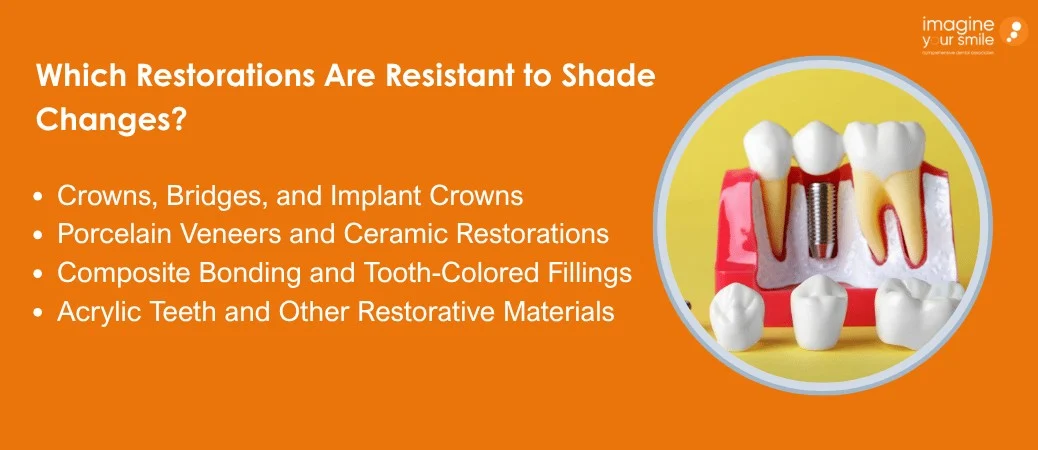
Crowns, Bridges, and Implant Crowns
Crowns, bridges, and implant crowns are built from porcelain, ceramic, or zirconia and fired to a specific shade that stays fixed.
Whitening natural teeth around a front crown is one of the most common ways a mismatch shows up, since crowns are often placed on the most visible teeth.
If you have a bridge, keep in mind the connected teeth won’t whiten evenly with the rest of your smile either, since the whole unit is one solid piece.
Our crowns and bridges page covers how these restorations are matched to your smile in the first place.
Porcelain Veneers and Ceramic Restorations
Porcelain veneers and ceramic restorations resist staining well but never lighten with whitening treatment.
Veneers are designed to hold their color for years, which is a benefit for longevity but means they won’t track with any future whitening you do on the rest of your teeth.
If you already have porcelain veneers and want a brighter smile overall, the surrounding natural teeth are the only part whitening will affect. Learn more about how dental veneers can restore your smile.
Composite Bonding and Tooth-Colored Fillings
Composite bonding and tooth-colored fillings also hold their shade through whitening treatment, though they may show wear or discoloration over time from a different cause.
Composite resin can pick up surface stains from food and drink the same way enamel does, but the base material color set during placement won’t lighten with peroxide.
That means an older filling might look duller after whitening even though it hasn’t technically changed color, simply because the teeth beside it got brighter.
Acrylic Teeth and Other Restorative Materials
Acrylic teeth, often used in dentures or temporary restorations, follow the same rule as other restorative materials and stay at their manufactured shade.
If you wear a partial denture or have acrylic-based dental work, whitening your remaining natural teeth can create a visible difference between the acrylic piece and your new tooth color.
How to Plan Whitening Around Existing Dental Work
Whitening works best when it happens before new visible restorations are placed, not after.
Getting the order right protects your investment in dental work and prevents the frustrating experience of a crown or veneer that suddenly looks darker than the teeth around it.
When Whitening Can Help Natural Teeth Blend With Restorations
Whitening can help your natural teeth blend with existing restorations when the restoration is already lighter than your current tooth shade.
If your crown or filling was placed years ago and matched a brighter smile, whitening your natural teeth back up can actually close that gap instead of widening it.
A cosmetic consultation with your dentist can confirm whether this applies to your situation before you start any whitening treatment.
Why Whitening Should Come Before New Visible Restorations
Whitening should always happen before a new crown, veneer, or filling is fabricated for a front tooth.
Fabricating a restoration to match your current shade, then whitening afterward, guarantees a mismatch because the restoration has no way to lighten along with your natural teeth.
Whitening first lets your dentist select a shade guide reading that reflects your final, brightened smile before any porcelain or composite work is fabricated.
How Long to Wait Before Shade Matching
Wait at least two weeks after professional in-office whitening before your dentist takes a shade match for a new restoration.
Teeth go through a rebound period right after bleaching, with the fastest color shift happening in the first 24 hours and most of the settling finished within two to three weeks.
At-home custom tray whitening tends to settle a bit faster, so one to two weeks is often enough before shade matching.
Waiting the full period means your new crown or veneer gets built to match the shade your teeth actually settle at, not a temporarily brighter one.
When Replacement Is the Only Way to Correct a Mismatch
Replacement becomes the only real fix when a highly visible restoration, like a front crown or veneer, is noticeably lighter than your restoration but darker than your newly whitened teeth.
In these cases, a cosmetic dentist can remake the restoration in a shade that matches your current smile.
This is a bigger step than whitening, but for front teeth it’s often the difference between a smile that looks uniform and one that draws attention to the mismatch.
At Imagine Your Smile, planning this sequence with your cosmetic dentist before you whiten helps you avoid paying for a restoration twice.
Professional Options, Safety Checks, and Maintenance
Professional whitening is safe for most people with existing dental work, as long as your dentist reviews your restorations and oral health history first.
The right approach depends on how many restorations you have, where they sit, and how sensitive your teeth tend to be.
In-Office Whitening vs. Dentist-Supervised Take-Home Treatment
In-office whitening delivers faster, more dramatic results in a single visit, while take-home trays offer a gentler, more gradual shade change with less rebound.
Both are considered professional teeth whitening options when supervised by a dentist, and the choice often comes down to timeline and sensitivity tolerance.
| Feature | In-Office Whitening | Dentist-Supervised Take-Home |
| Speed of results | Fast, often one visit | Gradual, over 1-2 weeks |
| Shade rebound | Slightly faster rebound | More stable long-term |
| Sensitivity risk | Higher during treatment | Lower, more controlled |
| Best for | Special events, quick timelines | People with sensitive teeth |
When a Professional Cleaning Can Refresh Dental Work
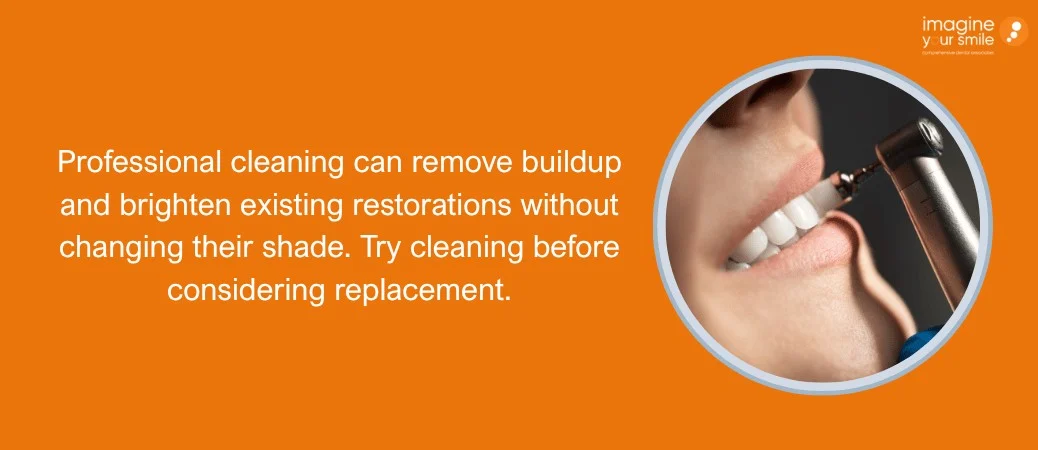
A professional cleaning can refresh the appearance of existing dental work without touching its actual shade.
Polishing removes surface buildup and plaque from crowns, veneers, and fillings, which can make older restorations look brighter and less dull, even though the material color underneath hasn’t changed.
This is worth trying before assuming a restoration needs replacement. Sometimes what looks like a mismatch is really just a restoration that needs a good cleaning.
Managing Tooth Sensitivity and Gum Irritation
Tooth sensitivity and gum irritation are the most common side effects of professional whitening, and both are usually temporary.
Sensitivity typically fades within a day or two after treatment ends, and desensitizing toothpaste with potassium nitrate used before whitening can reduce discomfort.
Gum irritation often comes from gel contact during application, which a well-fitted tray or careful in-office technique helps prevent.
Tell your dentist about any history of gum recession or gum disease before starting, since these conditions can affect how comfortable whitening feels.
When Whitening Should Wait for Dental Treatment
Whitening may need to wait if you have untreated cavities, active gum disease, unresolved symptoms after recent dental treatment, or visible restorative work that still needs to be completed.
Your dentist can determine whether your teeth and gums are ready for whitening.
If you have fluorosis or another cause of intrinsic discoloration, a cosmetic consultation can help set realistic expectations before you begin.
A Coordinated Plan Creates a More Natural-Looking Smile

A coordinated plan between whitening and any restorative work gives you the best shot at a uniform smile that looks natural from every angle.
Whitening first, waiting for your shade to settle, then matching any new dental work to that final color is the sequence that prevents the two-tone look so many people want to avoid.
A coordinated smile makeover can combine whitening with carefully timed restorative treatment when changes to tooth color, shape, and existing dental work need to be planned together.
At Imagine Your Smile, a cosmetic consultation can map out that order before any treatment begins, so your brighter smile and your dental work move forward together instead of working against each other.
Frequently Asked Questions
Can professional whitening whiten crowns, veneers, or fillings?
No, professional whitening cannot change the color of crowns, veneers, or fillings.
These restorations are made from porcelain, ceramic, zirconia, or composite resin, materials that don’t absorb whitening gel the way natural tooth enamel does.
Will whitening damage my existing dental work?
Whitening gel doesn’t damage crowns, veneers, or fillings when applied correctly under professional supervision.
It simply won’t change their color, and a dentist can advise on gel placement to avoid unnecessary contact with restoration margins.
Should I whiten my teeth before getting a crown or veneer?
Yes, whitening before a new crown or veneer is strongly recommended. This lets your dentist match the new restoration to your brightened, final tooth shade instead of your original color, avoiding a mismatch down the road.
How long should I wait after whitening before shade matching a new crown?
Wait about two weeks after in-office whitening and one to two weeks after take-home tray whitening before shade matching. This gives your tooth color time to stabilize after the initial rebound period that follows bleaching.
What should I do if my crown looks darker after whitening?
Talk to your dentist about your options, which usually include touch-up whitening on the surrounding teeth or replacing the crown to match your new shade. A cosmetic consultation can help you weigh cost, timing, and how visible the crown is in your smile.
Why don’t my teeth look much whiter after professional whitening?
Limited results can happen if your discoloration comes mostly from restorations rather than natural enamel, since whitening only affects natural tooth structure.
Deep intrinsic stains, certain medications, or fluorosis can also respond more slowly to whitening than typical surface staining.