Choosing between dental implant options can feel overwhelming, especially when you’re trying to figure out how long you’ll be out of commission. Recovery time plays a big role in your decision, affecting everything from when you can return to work to what you’ll eat for the next few weeks.
All-on-4 dental implants typically offer a faster recovery time compared to traditional full mouth dental implants, with most patients returning to normal activities within one to two weeks, while full mouth implants may require several months of healing between procedures.
The All-on-4 treatment uses just four implants per arch, which means less surgery and quicker healing. Full mouth implants involve placing individual implants for each missing tooth, which can extend your recovery period.
Understanding what to expect during recovery helps you plan ahead and make the best choice for your lifestyle.
The differences between All-on-4 and traditional implants go beyond just the number of implants, they affect your healing timeline, comfort level, and how quickly you can get back to enjoying your favorite foods.
Key Takeaways
- All-on-4 implants generally heal faster than full mouth implants because they use fewer implants and less invasive surgery
- Recovery from All-on-4 takes about one to two weeks for basic healing, while full mouth implants may require multiple procedures spread over several months
- Both options require several months for complete bone integration, but All-on-4 lets you leave with temporary teeth on the same day as surgery
Table of Content
- Overview of All-on-4 and Full Mouth Dental Implants
- Recovery Timeline: All-on-4 Dental Implants
- Recovery Timeline: Full Mouth Dental Implants
- Factors Affecting Recovery Time for Each Method
- Comparative Insights: Speed, Comfort, and Lifestyle Impact
- Frequently Asked Questions
Overview of All-on-4 and Full Mouth Dental Implants
All-on-4 uses four strategically placed implants to support a full arch of prosthetic teeth, while full mouth implants typically require six to eight implants per arch for tooth replacement.
Both options provide permanent solutions for full-mouth restoration, but they differ in the number of implants needed and the placement techniques used.
What Is the All-on-4 Dental Implant System?
The All-on-4 dental implant system replaces an entire upper or lower arch of teeth using just four implants. These implants act as anchors for a fixed bridge of prosthetic teeth.
Two implants are placed vertically at the front of your jaw. The other two are positioned at an angle toward the back. This angled placement lets you avoid areas with bone loss and maximizes support without needing bone grafts.
All-on-4 implants offer immediate results, and you can often leave the dentist’s office with a temporary set of teeth on the same day. The final prosthetic teeth attach to the implants to create a stable, natural-looking smile.
This approach works well if you have some bone loss because the angled implants use your existing bone more efficiently.
What Are Full Mouth Dental Implants?
Full mouth dental implants, also called full arch implants or implant-supported dentures, use more implants than the All-on-4 system. You’ll typically need six to eight implants in each arch to support your new teeth.
These implants are spread evenly across your jawbone. This creates a wider base of support for your bridges or crowns. The extra implants provide more stability and distribute chewing forces more evenly throughout your jaw.
Full arch implants offer a high degree of customization and can be designed to fit your mouth perfectly. They work well if you have good bone density and want maximum support.
The additional implants mean more surgical work, but they can handle heavy chewing forces better over time.
Traditional Implants vs. All-on-4: Key Differences
The main differences between traditional implants and All-on-4 dental implants involve the number of implants, bone requirements, and treatment timeline.
Number of Implants
- All-on-4: Uses exactly four implants per arch
- Traditional full mouth implants: Requires six to eight implants per arch
Bone Requirements All-on-4 implants need less bone structure because of the angled placement. This makes them a good choice if you have bone loss. Traditional implants need more bone density since they use vertical placement and more implants overall.
Treatment Time You can get temporary teeth on the same day with All-on-4 dental implants. Traditional full mouth implants usually take longer because more implants need to be placed and heal before attaching your final prosthetic teeth.
Cost Considerations All-on-4 implants are usually more cost-effective since they require fewer implants and less surgical time. Traditional implants cost more due to the additional implants and procedures needed.

Recovery Timeline: All-on-4 Dental Implants
The All-on-4 recovery process follows a predictable pattern from surgery day through complete healing, typically spanning 3 to 6 months. Your body goes through distinct phases as the implants bond with your jawbone while you adjust to eating, speaking, and caring for your new smile.
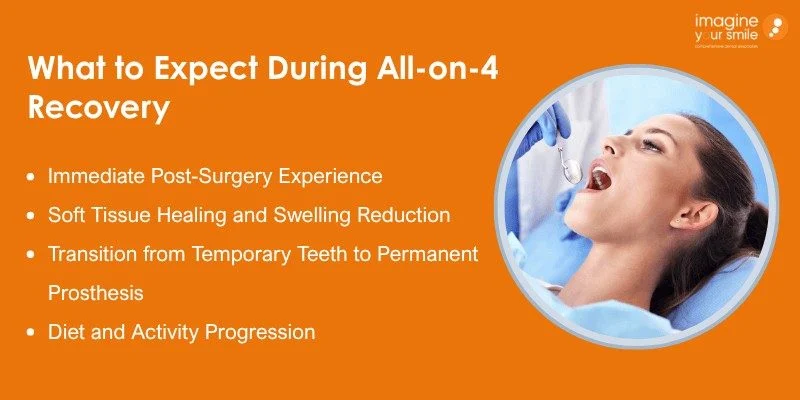
Immediate Post-Surgery Experience
You’ll leave the dental office with temporary teeth already attached to your four implants. This means you won’t go without teeth during healing. The numbness from anesthesia wears off in about 4 to 5 hours.
Swelling and discomfort peak within the first 48 to 72 hours after your implant procedure. You might notice bruising around your cheeks and jaw. This is completely normal.
Your dentist will prescribe pain medication to keep you comfortable. Apply ice packs for 20 minutes on and 20 minutes off during the first day or two. Sleep with your head elevated on extra pillows to help reduce swelling faster.
What to expect in the first 72 hours:
- Peak swelling and soreness
- Some bleeding or oozing at implant sites
- Difficulty opening your mouth wide
- Fatigue from the procedure
Avoid touching the surgical sites with your tongue or fingers. This protects implant stability during the critical early healing phase.
Soft Tissue Healing and Swelling Reduction
Your gums and soft tissues heal much faster than the bone. Most surface healing happens within 2 to 4 weeks after implant placement.
Swelling starts dropping noticeably around day 4 or 5. By week two, you’ll look and feel much more like yourself. The recovery process during these early weeks requires gentle care to protect your oral health.
Rinse with warm salt water after meals starting 24 hours after surgery. Don’t swish aggressively. Let the water gently move around your mouth. Use a soft toothbrush to clean your temporary teeth, being careful around the gum line.
Minor sensitivity is normal during this phase. Contact your dentist if you notice increased pain, excessive swelling, or signs of infection.
Transition from Temporary Teeth to Permanent Prosthesis
While you wear temporary teeth, osseointegration happens beneath the surface. This is when your jawbone fuses with the titanium implants. The process takes 3 to 6 months to complete.
Your dentist will monitor implant stability at follow-up appointments. Once osseointegration is complete, you’ll return to have your permanent prosthesis installed. Many patients receive zirconia bridges as their final restoration because of the material’s strength and natural appearance.
The permanent teeth look better and function more naturally than the temporaries. They’re custom-made to match your facial features and bite pattern. This final step in dental implant healing marks the true completion of your All-on-4 recovery.
Diet and Activity Progression
Your diet expands gradually as healing progresses. Start with liquids and very soft foods for the first few days.
Week 1-2: Stick to mashed potatoes, yogurt, smoothies, scrambled eggs, and protein shakes. Avoid anything that requires chewing.
Week 3-4: Add soft pasta, well-cooked vegetables, fish, and ground meat. Still avoid hard, crunchy, or sticky foods.
Month 2-3: Gradually introduce firmer foods as your dentist approves. Most people can eat normally by month 3, though some foods may need to wait until permanent teeth are placed.
Avoid strenuous exercise for 7 to 10 days after implant surgery. Heavy lifting and intense workouts can increase bleeding and swelling. Walking and light activities are fine. Listen to your body and don’t push too hard too soon.
Want a faster recovery after dental implants? Schedule a consultation to explore your best options.
Recovery Timeline: Full Mouth Dental Implants
Full mouth dental implants typically require 8-12 months for complete healing, with multiple surgical phases and extended recovery periods between each step. The timeline varies based on whether you need bone grafting and how quickly your jawbone integrates with the titanium implants.
Typical Healing Phases
Understanding full mouth dental implants healing time involves three distinct phases. The first phase focuses on evaluation and preparation, which includes tooth extractions and any necessary bone grafts.
If you need bone grafting, this phase alone can take 3-6 months to heal properly.
The second phase involves placing the dental implant screws into your jawbone. This surgical procedure takes 1-2 hours, but the healing period lasts another 3-6 months. During this time, osseointegration occurs as your bone grows around the titanium posts to create a stable foundation.
The final phase involves attaching your permanent crowns or bridge to the healed implants. Your total recovery time for a full mouth restoration depends heavily on your bone density and whether complications like implant failure occur.
Role of Bone Grafting in Recovery
Bone grafting significantly extends your recovery timeline but proves essential for long-term implant stability. You’ll likely need a bone graft if you’ve been missing teeth for a long time or have poor bone density in your jaw.
The graft material encourages new bone growth to support your implants.
A sinus lift may be required for upper jaw implants when there’s insufficient bone height. This procedure adds bone below the sinus cavity and requires additional healing time before implant placement. Your jawbone needs to fully integrate with the graft material before moving forward.
The bone grafting healing period typically spans 3-6 months. During this time, your body builds new bone tissue that will eventually anchor your implants securely.
Permanent Restoration Placement
Your permanent teeth get attached only after complete osseointegration has occurred. This final step happens 6-12 months after your initial surgery, depending on your individual healing progress.
Your dentist will verify implant stability through imaging and physical examination before proceeding.
The placement appointment itself is relatively quick and minimally invasive. Your custom-made bridge or individual crowns get secured to the healed titanium posts. Most patients experience minimal discomfort during this final phase compared to the initial surgery.
You may need temporary teeth between the implant placement and final restoration. These protect your implants while allowing you to eat and speak normally during the extended healing period.
Factors Affecting Recovery Time for Each Method
Both All-on-4 and full mouth dental implants have unique factors that influence how quickly you heal. Your bone density, treatment approach, and potential complications all play important roles in determining your recovery timeline.

Bone Density and Bone Loss
Your bone density directly impacts how well your implants integrate with your jawbone. If you have significant bone loss, full mouth dental implants may require bone grafting procedures before implant placement, which can add three to six months to your recovery time.
All-on-4 implants work differently because they’re angled to use existing bone more efficiently. This means you might avoid bone grafting even if you have some bone loss. The implants are strategically placed in areas of your jaw where bone density is naturally stronger.
Several factors influence the healing time for dental implant procedures, with bone quality being one of the most critical.
Dense, healthy bone allows for faster osseointegration, while weakened bone requires more time and potentially additional procedures to ensure implant stability.
Personalized Treatment Plans
Your dental team creates a personalized treatment plan based on your specific oral health needs and conditions. This customized approach considers your medical history, lifestyle habits, and the current state of your teeth and gums.
All-on-4 procedures typically follow a more standardized protocol with four implants per arch. Full mouth dental implants may require anywhere from six to eight implants per arch, depending on your unique situation.
The complexity of your implant procedure affects your recovery duration.
Factors like diabetes, smoking, and certain medications are evaluated in your personalized treatment plans to minimize healing complications. Your dentist adjusts the timeline and aftercare instructions based on these individual circumstances.
Risk of Complications and Implant Failure
Implant failure is rare but can extend your recovery significantly if it occurs. All-on-4 implants distribute force across four anchor points, which can sometimes mean that if one implant has issues, it affects the entire restoration.
With full mouth dental implants, individual implants can be addressed without necessarily compromising the entire arch. However, the larger number of implants means more potential sites where complications could develop.
Infection, poor oral health before surgery, and not following post-operative care instructions increase your risk of complications. Both procedures require the same vigilance in maintaining cleanliness and attending follow-up appointments to catch any issues early.
Comparative Insights: Speed, Comfort, and Lifestyle Impact
All-on-4 typically offers faster initial recovery and less invasive surgery compared to full mouth dental implants. The fixed denture approach differs significantly in how quickly you can return to normal activities and enjoy your new smile.

Invasive Surgery and Patient Experience
All-on-4 requires less invasive surgery because only four implants support your entire arch. This means fewer incisions and less bone work during your procedure. You’ll experience less swelling and discomfort in the first few days.
Full mouth dental implants involve placing 6-10 implants per arch. Each implant site needs individual attention, which extends your time in the surgical chair. More implant sites mean more areas that need to heal.
Your comfort level after surgery depends heavily on the number of implants placed. With All-on-4, many patients report managing pain with over-the-counter medication within 3-5 days. Full mouth implant patients often need prescription pain relief for a full week or longer.
Pain Management Timeline:
- All-on-4: 3-5 days of moderate discomfort
- Full mouth implants: 7-14 days of discomfort
Most All-on-4 patients receive a temporary restoration the same day as surgery. This immediate functionality helps you adapt more quickly to your new teeth.
Return to Daily Life and Oral Function
You can usually return to work within 3-5 days after All-on-4 surgery if your job doesn’t require heavy physical activity. The fixed denture design lets you speak and smile with confidence almost immediately.
Full mouth dental implants typically require 7-10 days before you feel ready to resume normal activities. You might wear temporary dentures during the healing phase, which can feel less secure than the All-on-4 fixed option.
Your diet restrictions last about 6-8 weeks with All-on-4. You’ll start with soft foods and gradually add firmer options as your gums heal around the temporary restoration.
Full mouth implants often require similar dietary changes, but individual healing sites might need extra caution.
Dietary Timeline:
- Week 1-2: Liquids and very soft foods
- Week 3-4: Soft foods like pasta and eggs
- Week 5-8: Gradual return to normal foods
Long-Term Stability and Success
All-on-4 implants show success rates of 94-98% after 10 years when properly maintained. The angled placement technique provides excellent stability without requiring bone grafts in most cases.
Full mouth dental implants achieve similar long-term success rates of 95-98%. The additional implants can distribute bite forces more evenly across your jaw. This might benefit your oral health if you have strong jaw muscles or grind your teeth.
Your cosmetic dentistry results depend more on the quality of your restoration than the number of implants. Both options can deliver beautiful, natural-looking teeth. Schedule a consultation to discuss which approach better suits your bone structure and lifestyle needs.
Frequently Asked Questions
Recovery times vary between these two implant options, with All-on-4 typically offering faster initial healing while both require several months for complete bone integration.
What’s the average healing period for All-on-4 dental implants?
The initial recovery period for All-on-4 implants usually takes about one to two weeks. During this time, you’ll experience some swelling and discomfort that gradually improves.
Complete osseointegration, where the implants fuse with your jawbone, takes three to six months. However, you can often use temporary teeth during this healing period. This means you won’t have to go without teeth while your implants fully integrate.
How does the recovery experience differ between All-on-4 implants and traditional full mouth implants?
All-on-4 implants require only four implants per arch, which means less surgery and typically less post-operative discomfort. Traditional full mouth implants may need eight to ten implants per arch, resulting in more surgical sites that need to heal.
All-on-4 implants can often avoid bone grafting because the implants are angled strategically. Traditional implants sometimes require bone grafting procedures, which can add several months to your overall recovery timeline.
The All-on-4 procedure can often be completed in a single day with temporary teeth placed immediately. Traditional full mouth implants may require multiple surgeries spread over several appointments.
Are there any specific aftercare instructions for faster recovery with All-on-4 implants?
You should stick to soft foods for the first few weeks after your All-on-4 procedure. This helps protect the implant sites while they begin to heal. Avoid hard, crunchy, or sticky foods during this initial period.
Keep your mouth clean by gently rinsing with salt water several times a day. Your dentist will provide specific instructions about when you can resume normal brushing around the implant sites.
Avoid smoking and drinking through straws, as these activities can interfere with healing. Take any prescribed medications as directed and attend all follow-up appointments so your dentist can monitor your progress.
What factors could affect the healing time after getting full mouth dental implants?
Your overall health plays a big role in how quickly you heal. Conditions like diabetes or autoimmune disorders can slow down the healing process.
Smoking significantly impacts healing time and can increase the risk of implant failure. Your age also matters, as younger patients typically heal faster than older patients.
The quality and density of your jawbone affect how quickly osseointegration occurs. Poor oral hygiene after surgery can lead to infections that delay healing. Following your dentist’s aftercare instructions carefully gives you the best chance for a smooth recovery.
Can you describe the overall timeline for the full integration of All-on-4 dental implants?
The first 24 to 48 hours after surgery involve the most noticeable swelling and discomfort. You’ll likely want to rest and stick to very soft foods during this time.
Week one through two brings gradual improvement in comfort and reduced swelling. Most patients can return to work and normal activities within a few days to a week.
Months two through six mark the osseointegration phase where your bone grows around the implants. Your temporary restoration allows you to eat and function normally during this period.
After three to six months, your dentist will place your permanent prosthetic teeth once the implants have fully integrated.
Is there a difference in the success rates between All-on-4 and traditional full mouth dental implants related to recovery time?
Both All-on-4 and traditional implants have high success rates when placed by experienced professionals. Studies show success rates above 95% for both procedures.
The shorter surgery time with All-on-4 may reduce the risk of complications during the initial healing phase. However, if one of the four implants in an All-on-4 system fails, it can affect the entire restoration.
Traditional implants spread the load across more individual implants, which can provide redundancy if one implant has issues. Your individual circumstances, bone health, and how well you follow aftercare instructions have more impact on success than the type of implant system chosen.