Research summary
The strongest conclusion from evidence published or updated during roughly 2021–2026 is that dental anxiety remains a substantial barrier to U.S. dental care, while reliable sedation dentistry utilization rates remain difficult to establish nationally.
Available evidence suggests that professional capacity to provide sedation is expanding modestly rather than undergoing a dramatic nationwide surge.
The important qualification is that the United States does not currently have a comprehensive annual national dataset counting adult sedation dentistry procedures by level: nitrous oxide, oral minimal sedation, moderate sedation, deep sedation, or general anesthesia.
Recent research therefore relies on surveys, insurance data in selected populations and, most importantly, state sedation-permit records as a proxy for availability.
The best recent multi-state longitudinal study found that, among states with complete records, the average proportion of dentists holding moderate-sedation permits rose from 7.42% in 2015 to 8.11% in 2023, a 9.28% relative increase.
Moderate-sedation permits per 100,000 residents increased from 5.21 to 5.71. By contrast, dentists holding deep-sedation/general-anaesthesia permits increased only from 4.33% to 4.46%, suggesting a broadly stable rather than rapidly expanding deep-sedation workforce.
These are measures of provider capacity, not the number of patients actually sedated.
For Woodbury, Minnesota, no credible public dataset identified in this review isolates sedation procedures at city level.
The most useful local evidence is therefore Minnesota-wide Medicaid survey, claims, coverage and regulatory data.
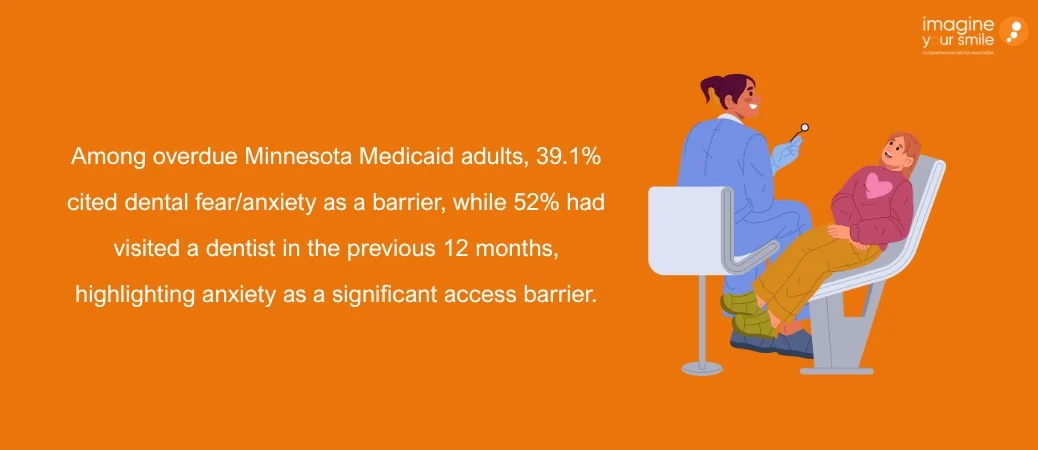
That evidence is striking: among surveyed Minnesota adult Medicaid beneficiaries who had not seen a dentist in the preceding year, 39.1% identified fear/anxiety as a reason, virtually equal to affordability at 40.3%, although provider-access problems were still the leading category at 62.7%.
Key evidence at a glance
What recent data show about dental anxiety and avoidance
Dental fear prevalence depends heavily on how fear is defined and measured.
The National Institute of Dental and Craniofacial Research states that nearly one in five U.S. adults experience moderate-to-high dental fear and anxiety that can prevent them from seeking needed oral care. NIDCR simultaneously identifies financial barriers and insurance access as major reasons adults forgo dental care, showing that avoidance cannot be attributed to anxiety alone.
A newer 2025 Journal of the American Dental Association study provides a much higher figure, but it measures something different.
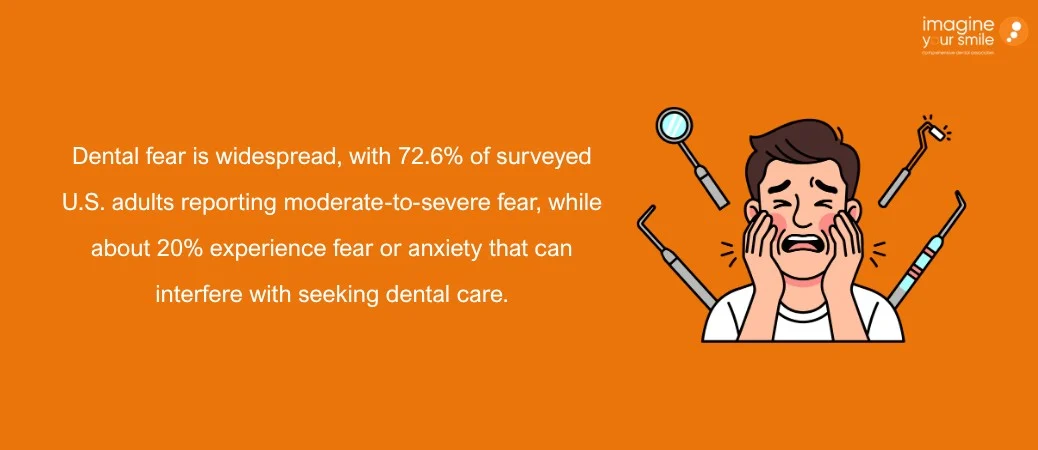
A census-matched online survey of 1,003 U.S. adults conducted from 31 October to 11 November 2024 found 72.6% had moderate-to-severe dental fear on the validated Gatchel single-item 0–10 scale: 45.8% moderate and 26.8% severe. The authors concluded that dental fear remained widespread.
The 72.6% figure should therefore not be interpreted as meaning that almost three-quarters of Americans avoid dentists, nor as proof that anxiety tripled during the past five years. NIDCR’s approximately 20% figure concerns anxiety sufficiently important to interfere with obtaining care, whereas the 2024 survey identifies a broader spectrum of self-reported fear.
Differences in measurement instruments and thresholds make a direct time trend inappropriate.
CareQuest Institute’s nationally oriented 2021 survey of 5,320 adults provides additional evidence of the severe end of the spectrum. Nearly 3% reported being so frightened or nervous at their last dental appointment that treatment became difficult or did not succeed.
Hispanic respondents were more than twice as likely as White respondents to report dental fear, and 60% of respondents reporting fear at their most recent appointment were women.
The broader utilization environment is also important. ADA Health Policy Institute data indicate that only 45% of the overall U.S. population had a dental visit during the preceding 12 months in 2022, including 40% of working-age adults.
ADA identifies affordability, fear and difficulty finding a convenient location or appointment among the leading reasons adults avoid dental visits.
In other words, sedation can address one important barrier (fear) but cannot by itself solve insurance, provider-capacity, or affordability constraints. For patients who have postponed care and now need to repair or replace damaged or missing teeth, restorative dentistry can address those dental needs while comfort options are considered separately based on the individual patient.
How sedation dentistry utilization has changed

The central research problem is that sedation utilization and sedation availability are not the same thing.
The most important recent U.S. longitudinal study, published in 2025, contacted dental boards in all 50 states and Washington, D.C., but only 11 states/jurisdictions had sufficiently complete moderate-sedation permit data, 10 had deep-sedation/general-anaesthesia data and four had historical stand-alone minimal-sedation data.
The investigators explicitly noted that an active permit does not reveal whether its holder is actually performing sedation, how many patients are treated or what kinds of patients receive it.
Nevertheless, those permits provide the clearest available signal of changing clinical capacity.
Across participating states, moderate-sedation permit prevalence increased from an average 7.42% of dentists in 2015 to 8.11% in 2023. Permit density increased 9.71%, from 5.21 to 5.71 per 100,000 population.
Growth was highly uneven. Texas increased from 15.25% to 21.17% of dentists holding moderate-sedation permits; Alaska rose from 2.64% to 4.58%, and Kentucky from 8.57% to 10.12%.
Conversely, Maine fell from 16.25% to 12.75%, California from 8.11% to 7.52%, and West Virginia from 2.74% to 1.95%.
This geographical divergence argues against describing sedation dentistry as following a single national adoption curve. State regulation, training requirements and professional practice patterns materially affect access.
Deep sedation/general anaesthesia changed much less overall. Average permit prevalence moved from 4.33% to 4.46% between 2015 and 2023, while permits per 100,000 population rose from 2.94 to 3.13.
California increased from 2.19% to 3.16% and Texas from 2.37% to 3.00%, whereas Maine declined from 14.20% to 11.56%.
Minimal-sedation trends are even harder to generalize because only four states supplied historical stand-alone permit data.
Colorado increased from 5.29% to 9.26% and Texas from 33.55% to 41.62% between 2015 and 2023, but permitting requirements differ between states, so those percentages cannot be treated as national utilization rates.
The defensible interpretation is therefore that U.S. sedation capacity (particularly moderate sedation) has expanded modestly in parts of the country, while deep sedation/general anaesthesia has remained comparatively stable. There is insufficient evidence to claim that actual nationwide patient sedation procedures increased by a specific percentage during 2021–2026.
This conclusion follows directly from the permit study’s incomplete state coverage and its inability to measure procedure volumes.
Woodbury and Minnesota evidence
Minnesota provides unusually useful information on the relationship between dental avoidance and anxiety, although the most recent survey evidence applies statewide rather than specifically to Woodbury.
The ADA Health Policy Institute surveyed 484 Minnesota adult Medicaid beneficiaries between December 2023 and January 2024.
The sampling was non-probability based, with quotas designed to represent the state’s adult Medicaid population, so its percentages should be treated as survey estimates rather than administrative prevalence figures. Only 52% reported a dental visit within the preceding 12 months, 33% last attended one to five years earlier, and 15% more than five years earlier.
Among the 233 respondents who had not visited within 12 months, multiple barriers could be selected:
62.7% cited provider access, 40.3% affordability and 39.1% fear/anxiety, while 14.6% reported no perceived need. The specific anxiety item was “I am afraid of going to the dentist”, selected by 39.1%.
That finding is particularly relevant for research around Woodbury: among lower-income Minnesotans already overdue for dental care, anxiety is almost as frequently reported as affordability, although difficulty obtaining a provider remains substantially more prevalent.
It therefore supports anxiety-management and sedation services as an access intervention, but it also suggests that sedation availability alone would leave major structural barriers unresolved.
Minnesota’s regulatory structure distinguishes lower-intensity from deeper sedation.
The Board of Dentistry states that practitioners providing only minimal sedation/anxiolysis do not require the same certification used for moderate or deep sedation; moderate/deep-sedation and general-anaesthesia providers are subject to credentialing and office inspection, with inspections required every five years after the initial inspection.
Minnesota rules separately regulate nitrous oxide, moderate sedation, deep sedation and general anaesthesia.
Coverage may also influence future use. Minnesota Medical Assistance expressly covers oral or IV sedation when a covered dental service cannot safely be performed without it or would otherwise require general anaesthesia in a hospital or surgical center.
State law also prohibits prior-authorisation requirements for these specified sedation services.
Public Minnesota claims dashboards are not adequate for calculating a Woodbury sedation rate. Minnesota Department of Health Medicaid claims data report whether enrollees received dental services but state explicitly that they do not identify specific procedure types.
The children’s CMS-416 “dental treatment” indicator similarly combines sedation/anaesthesia with oral surgery, restorations, crowns, root canals and other treatment.
Consequently, a statistically defensible Woodbury-specific sedation-utilization percentage cannot currently be derived from these public datasets.
Minnesota statewide data are the appropriate local proxy unless de-identified CDT-code-level claims or practice-level records become available.
What is driving change
Demand for anxiety management remains substantial, but the evidence suggests that future management will involve a mix of behavioural interventions and pharmacological sedation, rather than sedation replacing other approaches. In the 2024 census-matched U.S. study, 71.2% of respondents classified as fearful expressed interest in evidence-based digital dental-fear treatment delivered through computer, mobile or telehealth approaches.
At the same time, regulation is becoming more explicit about safety. The ADA issued comprehensively revised sedation and anaesthesia guidelines in April 2026, adopted by its House of Delegates in 2025.
Changes include updated physical-status and fasting recommendations, more precise weight-based dose documentation, body-mass index among baseline observations, supplemental oxygen recommendations for moderate sedation through general anaesthesia, and stronger expectations for emergency protocols and training drills.
These requirements make a rapid, frictionless expansion of deeper office-based sedation unlikely.
Moderate, deep, and general-anesthesia services require greater training, monitoring, emergency readiness and, depending on state law, permitting and facility oversight.
For patients planning extensive treatment, such as full mouth reconstruction, comfort options can be considered as part of the broader treatment plan when clinically appropriate.
The national permit study likewise found far fewer dentists holding deep-sedation/GA permits than moderate-sedation permits and attributed interstate variation partly to differences in training and regulatory requirements.
The trend is consequently better described as professionalisation plus selective expansion: increased capability in some markets, accompanied by stronger standards governing who provides sedation and under what conditions.
Sedation may also be considered when appropriate for patients undergoing longer or more involved procedures, including dental implant treatment, particularly when anxiety makes treatment difficult. For patients whose care involves several procedures or more complicated restorative needs, advanced treatment planning for complex cases can help coordinate treatment needs before care begins.
Outlook beyond 2026 and research implications
No high-quality source reviewed here supports a precise national forecast such as “sedation dentistry will grow by X% annually”.
Commercial market forecasts often combine dental sedation with broader anaesthesia markets and do not measure actual U.S. dental procedures. For research purposes, a scenario-based projection is more defensible.
Minimal and moderate sedation are likely to show gradual, geographically uneven expansion after 2026.
This is an inference supported by the modest rise in moderate-sedation permits through 2023, continuing high levels of dental fear and state policies such as Minnesota’s coverage of medically necessary oral/IV sedation.
States with easier training/permit pathways and adequate reimbursement may expand faster than jurisdictions with more restrictive regulatory structures.
Deep sedation and general anaesthesia are less likely to expand at the same rate. Permit prevalence was almost flat overall through 2023, and the 2026 ADA framework strengthens monitoring, documentation, oxygen, emergency-preparedness and competency expectations.
These factors favour specialised, appropriately equipped providers rather than broad diffusion throughout general dental practices.
Sedation demand should not be equated with dental-anxiety prevalence. Many fearful patients continue treatment without sedation, some use nitrous oxide or behavioural techniques, and others avoid care because of cost or provider access rather than fear.
The 2024 evidence of strong interest in digital fear treatment suggests that scalable behavioural management could complement (and for some patients potentially reduce the need for) pharmacological sedation, although current evidence does not establish that such program have yet reduced U.S. sedation volumes.
For future research in Woodbury and the Minneapolis–Saint Paul region, the most useful outcome would be CDT-code-level claims tracking nitrous oxide/anxiolysis, moderate sedation and deep sedation/GA separately, linked where possible to patient-reported dental anxiety and delayed attendance.
Existing Minnesota public datasets cannot perform that analysis because specific procedure utilization is not released in the relevant dashboards.
Overall, the evidence through September 2026 supports a carefully qualified conclusion: dental anxiety has not disappeared as a major U.S. access problem; moderate-sedation provider capacity has increased modestly in the states where longitudinal data exist; deep-sedation/GA capacity has remained comparatively stable; and Minnesota data show that fear remains a particularly important contributor to treatment avoidance among Medicaid adults.
The major research gap is not evidence that anxiety exists, but the absence of a standard national system measuring how many anxious patients actually receive each level of dental sedation over time.
References
Full article: Trends in Dental Sedation Permits in Select U.S. States, 2015–2023
A census-matched survey of dental fear and fear-treatment interest in the United States – PubMed
Dental Fear Is Real. Providers Can Help. – CareQuest Institute
The Dental Care Market | American Dental Association
Trends in Dental Sedation Permits in Select U.S. States, 2015–2023 – DOAJ
Sedation Inspection Self Evaluation Process / Minnesota Board of Dentistry
About the Medicaid dental claims data – MN Data
ADA releases updated sedation and anesthesia guidelines | American Dental Association