
The vast majority of teeth lost in the United States result from preventable oral diseases and injuries. Dental caries (untreated cavities) and periodontal (gum) disease are the two leading causes of tooth loss.
Other contributors include tobacco use (which worsens gum disease), traumatic injuries (e.g. sports accidents or falls), extractions for orthodontic reasons, and congenital tooth agenesis (some teeth never form).
Systemic health conditions are also linked to tooth loss: adults with chronic diseases (like diabetes, heart disease or chronic respiratory conditions) are more likely to have severe tooth loss.
Conversely, good preventive care (daily brushing and flossing, regular dental check-ups, and community water fluoridation) can markedly reduce these risks.
Prevalence of tooth loss (edentulism)
Complete tooth loss (edentulism) has declined over decades but remains common among older adults.
National surveys find that only about 1–2% of U.S. adults aged 35–49 have lost all their natural teeth, but this rises sharply with age: roughly 5.9% of ages 50–64, 11.4% of ages 65–74, and 19.7% of ages ≥75 have no natural teeth remaining. This age pattern is illustrated below:
| Age (years) | % of Adults with All Natural Teeth Lost |
| 35–49 | 1.2% |
| 50–64 | 5.9% |
| 65–74 | 11.4% |
| ≥75 | 19.7% |
(Data source: CDC’s 2024 Oral Health Surveillance Report.)
Minnesota’s rates among older adults are somewhat better than national averages. A CDC analysis of 2012 data found that only about 9.5% of Minnesota adults aged 65+ had lost all their teeth due to decay or gum disease – significantly below the U.S. median of 14.7% for that age group (About 51.6% of Minnesota 65+ had lost at least some teeth, vs. 56.1% nationally).
More recent federal surveys also show that Minnesota ranks high nationally in fluoride coverage and dental access, factors that help preserve teeth. At the city or county level, specific surveys are limited. However, Woodbury’s population – part of suburban Washington County – tends to be relatively affluent and well-educated, factors usually linked to lower tooth loss.
Woodbury’s drinking water is fluoridated (meeting Minnesota’s optimum of ~0.7 mg/L), which helps prevent cavities across the community.
Edentulism by demographic factors
Tooth loss is strongly patterned by race, income, education and insurance. Even among seniors, non-Hispanic Black and low-income adults lose far more teeth than better-off peers.
For example, about 25% of non-Hispanic Black older adults have lost all teeth, compared to 15% of Hispanic and 11% of non-Hispanic white older adults. Similarly, complete tooth loss was over three times more common among 65+ adults with less than a high school education (33%) than those with higher education (10%).
Low-income seniors had edentulism around 30%, versus ~12% for higher-income seniors. In younger populations, lack of dental insurance and poverty likewise double or triple the risk of untreated decay and tooth loss.
Minnesota’s Woodbury area largely follows these patterns: wealthier suburbs have fewer missing teeth than lower-income or rural areas.
Health burden of untreated oral disease
Lost teeth and poor dental health impose a major burden on individuals and society. Untreated decay and missing teeth cause chronic pain, chewing difficulties, poor nutrition and social stigma.
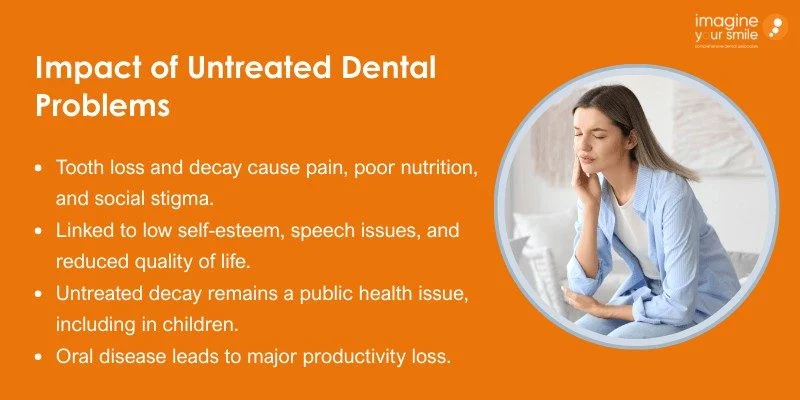
CDC notes that tooth loss can lead to low self-esteem, impaired speech and reduced quality of life. Nationally, dental problems also drive millions of costly emergency room visits and time out of work or school.
One analysis found over 2 million U.S. ED visits for dental conditions in 2018; the most common issues were tooth loss (traumatic/extraction sequelae), tooth pulp diseases, and cavities. These dental ED visits totaled over $2 billion in charges in 2017.
Moreover, untreated oral disease costs Americans an estimated $45–46 billion per year in lost productivity. For example, CDC reports that U.S. adults lose about 34 million school hours annually to unplanned dental problems, and similarly tens of millions of work hours.
In Minnesota, untreated decay in children and adults has been documented as a major public health issue (about 20% of Minnesota 3rd graders have untreated cavities), so the productivity and quality-of-life impacts mirror national trends.
Cost implications (direct and indirect)
Direct dental treatment costs are high and growing. National dental expenditures exceed $140 billion annually. When routine care is foregone, costly consequences occur: extractions, dentures and emergency care are expensive.
For example, annual productivity losses (forgone wages, school/work hours) due to oral disease were estimated at $45.9 billion in 2015. Hospital and emergency costs (for conditions often stemming from advanced tooth decay or abscess) run into billions each year.
Indirect costs include management of poor nutrition and associated systemic disease that can follow dental disability. While Minnesota-specific dental spending is proportionally similar, recent state actions (below) aim to curb costs by improving prevention and access.
Access to dental care and insurance coverage
Inequities in insurance worsen tooth loss trends. Over a quarter of U.S. adults lack any dental coverage. Among seniors (Medicare-only), nearly two-thirds have no dental benefits.

Nationally, adults without insurance have about double the rate of untreated cavities (e.g. 43% vs 18%) compared to those with private coverage. Medicaid programs vary by state: although Minnesota historically cut adult dental Medicaid benefits in 2008, recent legislation (see below) is reversing that.
For children in Minnesota, Medicaid and CHIP provide extensive dental coverage, and uptake of fluoride/ sealants is high. In Woodbury (and most of the Twin Cities metro), numerous dentists serve both private and Medicaid patients, but provider shortage areas persist in some outlying communities.
Rural Americans overall often face a dental health professional shortage and must travel farther for care.
Worried about tooth loss? Book a dental exam to protect your smile before problems progress.
Disparities in outcomes and care
The burden of tooth loss falls disproportionately on disadvantaged groups. CDC notes that U.S. seniors in poverty or of minority race are far more likely to have severe tooth loss.
Lower-income people also have markedly higher rates of untreated cavities and gum disease. These disparities arise from complex causes: social determinants like education, income, neighborhood, diet, and historical discrimination lead to poor access to fluoridated water, dental care and healthy foods.
In Minnesota, similar gaps exist: recent state surveys show that low-income and rural Minnesotans visit dentists far less often than wealthier, urban residents.
For example, Minnesota data report that about 54% of low-income adults had a dental visit in a year, compared to ~75% for higher-income adults. (In Woodbury’s area, poverty is relatively low, but communities of color still face barriers: e.g. Minnesota American Indian and Black children have higher rates of caries than White children.)
Progress and initiatives in Minnesota and Woodbury
Minnesota has pursued multiple oral health initiatives. On prevention, ~99% of Minnesotans on public water (including Woodbury) receive fluoridated water. Statewide programs fund sealant clinics in schools and screenings for young and older populations.
In 2016 Minnesota completed its first Basic Screening Survey of older adults in long-term care, which documented high treatment needs and informed policy.
Importantly, recent legislation (2021–2023) has greatly expanded dental care access for low-income adults: Minnesota reinstated comprehensive dental benefits (including dentures) for Medicaid and MinnesotaCare enrollees effective Jan 1, 2024.
This follows doubling of Medicaid dental reimbursement rates to bring more providers into the program. These steps aim to reduce disparities by allowing seniors and low-income adults to keep more teeth.
Locally, Woodbury benefits from being in a well-resourced county. Washington County’s public health department periodically assesses community health (though separate oral health reports are limited). Woodbury’s fluoridated water system (with ~0.7 ppm fluoride) provides a strong community preventive measure.
The city also has several family dental practices and specialists, though like everywhere it faces occasional provider shortages. Woodbury participates in statewide oral health campaigns (e.g. outreach via schools and senior centers on dental hygiene).
Looking ahead, Minnesota’s State Oral Health Plan (2020–2030) emphasizes equity, with goals to increase the proportion of adults retaining functional dentitions (≥20 teeth) and to eliminate disparities. Progress on those goals will help reduce the burden of tooth loss regionally.
Summary
Tooth loss in the U.S. has declined over decades but remains a significant public health issue, especially among the disadvantaged. Causes include the leading oral diseases (cavities and gum disease), compounded by smoking, poor diet and limited care access.
Nationally about 12% of seniors are completely edentulous, but only ~10% of Minnesota’s seniors are (reflecting better prevention).
Within Minnesota, Woodbury residents generally enjoy good preventive services (e.g. fluoridation) and expanding Medicaid dental coverage, yet underlying disparities (race, income, rural status) still drive uneven outcomes.
Untreated oral diseases cost the health system billions (through ER visits) and cost the economy tens of billions (through lost work/school) each year.
Addressing tooth loss therefore requires continued emphasis on prevention (fluoride, sealants, education), expanded insurance coverage, and targeted outreach to vulnerable groups.
Recent Minnesota policies (adult dental Medicaid, dental homes) and Woodbury’s engaged community health efforts are promising steps toward lowering the oral health burden in this region.
Tables: Demographic Differences in Edentulism
| Group | % of Older Adults (65+) with All Natural Teeth Lost (Edentulism) |
| Non-Hispanic White (older adults) | 11% |
| Non-Hispanic Black (older adults) | 25% |
| Hispanic (older adults) | 15% |
| Less than High School education (older) | 33% |
| High School or more education (older) | 10% |
| Low income (older adults) | 30% |
| Higher income (older adults) | 12% |
(Source: CDC reports)
References (sources used): U.S. Centers for Disease Control and Prevention (CDC), National Center for Health Statistics, and Division of Oral Health; Minnesota Department of Health; National Institute of Dental and Craniofacial Research; Agency for Healthcare Research and Quality (HCUP Statistical Brief); Minnesota Dept. of Human Services.