
You’re ready to fill the gap from your missing teeth, and your dentist mentions you’ll need two separate procedures before your new tooth goes on. It’s normal to wonder why.
Some patients need two implant surgeries because dental implants are placed under the gum tissue and covered during healing, so a small second procedure is needed to uncover the implant and attach the abutment that holds your crown.
This approach is known as two-stage implant surgery, and it’s often chosen when your dentist wants the implant protected from bacteria and chewing forces while it fuses with your bone.
The extra step isn’t a setback. It’s a way to give your tooth replacement a stronger start.
Understanding the parts of a dental implant can also make it easier to see why the implant, abutment, and crown are completed at different stages.
Healing time between surgery and crown placement depends on your oral health, overall health, and whether you also need bone grafting.
Here’s how each stage works and what you can expect on the way to your permanent restoration.
Key Takeaways
- A two-stage dental implant process covers the implant under the gums while it heals, then reopens it later.
- Your dentist may suggest a second surgery when healing needs extra protection, such as with softer bone or slower healing.
- Once the abutment is in place and the gums settle, your final crown completes the tooth replacement.
How Two-Stage Dental Implants Work
The two-stage method splits your treatment into two small surgeries: one to place the titanium post in your jawbone, and one to uncover it later.
In between, your gum tissue is closed over the implant so the bone can bond to it without being disturbed.
The Implant Post Replaces Missing Tooth Roots
Your natural teeth have roots that sit inside the jawbone and hold the tooth steady. When you lose a tooth, those roots go with it.
A dental implant takes over that job. Your dentist or surgeon places a small titanium post into the bone where the root used to be.
During implant placement, a tiny opening is made in the gum, and the bone is shaped to match the size of the post. The post is then threaded into place.
A cover screw is placed on top to seal the inside of the implant. This keeps bone and soft tissue from growing where the abutment will later attach.
Covered Healing Protects the Implant Site
Here’s what makes this approach different. In a two-stage implant procedure, the gum tissue is stitched fully over the implant, so nothing shows above the gumline.
Compare that to a one-stage approach, where a healing abutment sits above the gums from day one.
Keeping the implant buried has a clear purpose:
- No chewing pressure on the implant while bone is still forming around it
- Less bacteria exposure at the healing surface
- Steadier soft tissue healing over the site
This matters most when the bone is soft, when a graft was added, or when the implant did not feel very tight at placement.
Osseointegration Creates a Stable Foundation
The waiting period isn’t wasted time. It’s when osseointegration happens, meaning your bone cells grow directly onto the rough surface of the titanium implant and lock it in place.
This usually takes about three to six months, depending on the site and your healing. Upper jaw sites often need longer than lower jaw sites.
Once that bond is solid, the second surgery is a short visit. The gum is opened again, the cover screw comes off, and a healing abutment goes on so the tissue can shape around it.
Most people find this second stage easier than the first and get back to normal activity within a day or two. After the gums settle, your crown can be attached.
Why a Second Surgery May Be Recommended
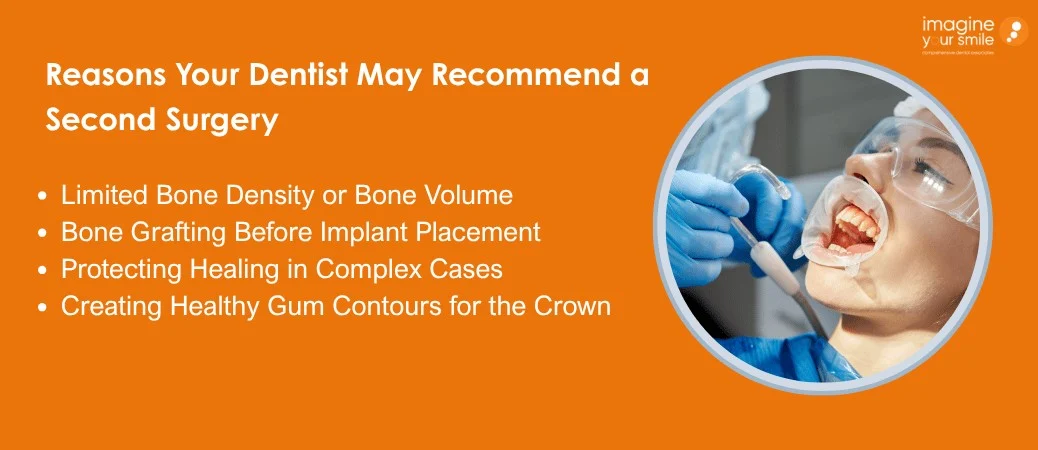
Your dentist may split treatment into two surgeries when your jawbone needs extra help, when healing needs protection, or when your gum tissue needs shaping before the crown goes on.
Each reason comes down to giving the implant a stable, healthy home for the long run.
Limited Bone Density or Bone Volume
Your implant needs enough bone to hold it tightly the moment it’s placed. That tight fit is called primary stability, and it’s a strong sign the implant will fuse with the bone.
Back teeth often have softer, less dense bone than front teeth. Softer bone makes it harder to lock the implant in place right away.
When bone volume is thin or density is low, your dentist may cover the implant with gum tissue and let it heal untouched for a few months.
This two-stage approach protects the implant from chewing pressure and mouth bacteria during that early period.
A second, minor surgery later uncovers the implant so the abutment and crown can be attached.
Bone Grafting Before Implant Placement
If you’ve had bone loss from a missing tooth, gum disease, or an old extraction, you may need a bone graft first.
A graft adds material to the jawbone so there’s enough width and height to support an implant. Grafts can be done at the same visit as implant placement or several months earlier, depending on how much bone is missing.
Here’s how that usually breaks down:
| Amount of bone loss | Typical plan |
| Small gaps | Graft and implant at the same visit |
| Moderate to large loss | Graft first, implant months later |
Larger grafts need time to mature into solid bone. Placing an implant too soon into a fresh graft raises the risk of implant failure.
Protecting Healing in Complex Cases
Some health factors slow down healing, and your dentist plans around them.
Diabetes, smoking, and certain medications can all affect how well bone and gums recover. In these cases, keeping the implant fully covered by gum tissue during healing shields it from plaque and biting forces.
Front teeth add another wrinkle. Because appearance matters so much there, your dentist may want more control over how the bone and gums settle before the final crown is made.
Two surgeries also make sense when you’re getting multiple implants or an implant-supported bridge, since more sites mean more healing to manage at once.
Creating Healthy Gum Contours for the Crown
Healthy gums frame your crown and help it look like a natural tooth.
At the second surgery, your dentist uncovers the implant and attaches a healing abutment. That small piece guides the gum tissue into the right shape around the implant over the next several weeks.
This step matters most for teeth people can see. Without it, gums can sit too high, too low, or unevenly around the crown.
Once the tissue settles, your dentist takes impressions so the lab can build a crown that matches your other teeth. Good gum health at this stage also makes daily cleaning easier, which helps your implant last.
What Happens at Each Surgical Stage
A two-stage implant means two separate appointments in the surgical chair, with several months of quiet healing in between. Here’s what your dentist does at each visit, and what your body is doing while you wait.
Stage One: Placing the Implant in the Jawbone
Your first surgery starts with numbing. Most single implant placements are done under local anesthesia, so you’re awake but comfortable, though sedation dentistry is an option if you feel anxious or need multiple implants.
Once you’re numb, your surgeon makes a small opening in the gum tissue to reach the bone underneath. A narrow channel is prepared in the jawbone using a series of drills at controlled speed.
The titanium implant post is then seated into that channel.
Here’s the part that makes it a two-stage procedure: instead of leaving a healing abutment sticking out, your surgeon places a low-profile cover screw and stitches the gum tissue completely over the implant.
Nothing shows in your mouth. Expect the appointment to last roughly 20 minutes to an hour per implant.
The Healing Period Between Procedures
This is the long stretch, and you won’t feel much of anything happening.
Osseointegration is the process where your jawbone grows directly against the surface of the titanium post and locks it in place.
It usually takes three to six months, sometimes longer if your bone is softer or you’re healing from a graft.
Covering the implant during this phase protects it from chewing forces, food particles, and bacteria while the bond forms.
What you’ll notice day to day:
- Swelling and soreness for the first two or three days
- A return to normal activity within about a week
- A temporary tooth or partial denture filling the gap in visible areas
- Check-in appointments so your surgeon can confirm progress
Smoking during this window raises the risk of poor integration, so it’s worth pausing if you can.
Stage Two: Uncovering the Implant and Adding the Abutment
Once imaging confirms the implant is solid, you come back for a much smaller procedure.
Your surgeon numbs the area again, then makes a small opening in the gum to expose the top of the implant post.
The cover screw comes out, and a healing abutment goes in, a rounded cap that sits above the gumline and shapes the tissue around it.
After a couple of weeks, the gum contours settle. Then impressions or a digital scan are taken, the final abutment is attached, and your custom crown is made to fit.
From Abutment to the Final Crown
Once your implant has fused with the bone and the abutment is in place, you’re in the home stretch.
The last few weeks focus on shaping your gum tissue, checking the fit of your new tooth, and locking the final restoration into place.

When a Temporary Crown May Be Used
After your second surgery, your gums need a little time to settle around the abutment. Many dentists place a temporary dental crown or a healing cap during this stretch.
A healing cap helps shape your gum tissue so the permanent crown has a natural-looking collar around it. Gum tissue usually heals around the connector in one to two weeks.
A temporary crown does more than fill a gap. It lets you chew soft foods, keeps neighboring teeth from drifting, and gives you something to smile with while the lab builds your final piece.
Just be gentle with it. Temporary crowns are held with mild cement and can pop off if you bite into something hard or sticky.
How the Permanent Crown Is Attached
Your dentist takes an impression or digital scan of the abutment, then sends it to a dental lab. Building your prosthetic crown usually takes two to three weeks.
At the final visit, the crown is tried in first. Your dentist checks:
- Color and shape against your nearby teeth
- Fit at the gum line, with no gaps or pressure points
- Bite as you tap, grind, and chew
- Contact with the teeth on either side, using floss
Then the crown is secured one of two ways. A cement-retained crown is glued onto the abutment.
A screw-retained crown attaches with a small screw through the top, which is then covered with filling material.
Screw-retained crowns are easier to remove later if a repair is ever needed. Cement-retained crowns often look slightly better in the front of your mouth.
Crown, Bridge, and Denture Options for Different Needs
The type of restoration you get depends on how many teeth you’re replacing.
| What You Need | Restoration | Implants Used |
| One missing tooth | Single dental crown | 1 |
| Three or four teeth in a row | Implant-supported dental bridge | 2–3 |
| A full arch | Implant denture or full-arch prosthesis | 4–6 |
A bridge spans the space between two adjacent implants, so you don’t need an implant for every single tooth. That keeps surgery and cost down.
For a full arch, your permanent restoration can be fixed in place or made to snap on and off for cleaning.
Your dentist will attach the abutments and seat the prosthesis at the same finishing appointment, then fine-tune the bite.
Talk through the choices before your second surgery. The plan for your tooth restorations affects where and how the implants are placed.
Recovery, Implant Care, and Long-Term Success
Healing after a two-stage implant takes time, and what you do at home matters just as much as what happens in the dental chair.
Simple habits like gentle cleaning, soft foods, and keeping your follow-up visits help protect your investment for years.
Managing Discomfort and Following Post-Operative Instructions
Most soreness peaks in the first two or three days, then fades. Swelling and light bruising are normal after either surgery.
Your dentist will likely suggest:
- Ice packs on your cheek for 15 minutes at a time during the first 24 hours
- Over-the-counter pain relievers or a prescription, taken as directed
- Soft foods like yogurt, eggs, and soup for about a week
- No smoking, straws, or vigorous rinsing, which can disturb the healing site
Rest for the first day or two, and skip heavy exercise. Salt water rinses usually start 24 hours after surgery.
Recovery timelines vary, but the full healing and recovery process runs longer than the initial soreness. Call your dentist if pain gets worse after day three or you notice fever or drainage.
Oral Hygiene Around an Implant Crown

An implant can’t get a cavity, but the gum and bone around it can still get sick. That condition is called peri-implantitis, and it’s one of the leading causes of implant failure.
Keep it simple:
| Habit | How Often |
| Brush with a soft brush | Twice daily |
| Flossing with implant floss or a water flosser | Once daily |
| Interdental brush around the crown | Daily, if your dentist recommends it |
| Professional cleaning | Every 3–6 months |
In one long-term study of implant-supported bridges, patients at higher risk for peri-implant and periodontal problems were seen every three to four months instead of every six.
Healthy gums help support the tissues around your implant, so treat gum health as part of your daily routine.
At Imagine Your Smile, we can monitor your implant, gums, and surrounding bone during regular checkups to help catch potential problems early.
Risk Factors That Can Affect Healing and Implant Success
Some things slow bone healing or raise your odds of trouble. Being honest with your dentist about them helps you plan ahead.
Watch out for:
- Uncontrolled diabetes, which slows tissue repair
- Smoking or vaping, which reduces blood flow to the gums
- Untreated gum disease in nearby teeth
- Teeth grinding, which puts extra force on the implant
- Certain medications, including some bone drugs and steroids
Bone quality and jaw location matter too. Implants in the lower jaw generally have fewer complications than those in the upper jaw, where bone is often softer.
Researchers point to several core factors behind long-term implant success, including good planning and consistent follow-up care. Keep your checkups, and small problems get caught early.
Frequently Asked Questions
Two-stage implant treatment adds a short second procedure to uncover the implant and attach a healing abutment, which is often chosen when bone is soft or healing may be slower.
Below are answers about timing, comfort, and when a single surgery works just as well.
Why do some patients need a second dental implant surgery before getting their crown?
In a two-stage approach, your gum tissue is closed completely over the implant after it is placed. That protects the titanium post from mouth bacteria and from any pressure while it fuses with your bone.
Because the implant is buried, a small follow-up procedure is needed later to reach it again.
Your dentist may pick this path if the bone is softer, if the implant needs extra stability, or if healing could be slowed by smoking or diabetes.
What happens during the second stage of a dental implant procedure?
The second visit is much shorter than the first. Your dentist numbs the area, makes a small opening in the gum, and exposes the implant so a healing abutment can be attached.
That abutment sticks up through your gum and helps shape the tissue around it. Once the gum settles, impressions or scans are taken so your crown can be made to fit.
How long do I have to wait between implant surgery and crown placement?
Most people wait several months. The healing period before a permanent crown often runs four to six months, since the bone needs time to bond firmly to the implant.
If a temporary crown is used, you may wear it for about four to six weeks while the dental lab builds the final one. Your own timeline depends on your bone quality, the tooth’s location, and whether you needed a bone graft.
Is a second implant surgery painful, and what is recovery like?
The visit itself should not hurt, because the area is numbed with local anesthetic. Many patients say it feels easier than the day the implant was placed.
Afterward, expect mild soreness and some puffiness in the gum for a few days. Over-the-counter pain relievers, cold packs, and softer foods usually handle it, and most people return to normal activities quickly.
Why might a healing abutment be placed in a separate procedure?
Placing the abutment later keeps the implant sealed under the gum during the most delicate weeks of healing. Even tiny movement early on can interfere with the bond between bone and implant.
Waiting also gives your dentist a second chance to check how the site healed before moving toward the crown stage. For front teeth, shaping the gum at this point helps the final result look natural.
Can dental implants be completed in one surgery instead of two?
Yes. With a one-stage system, the healing abutment is attached the same day the implant goes in, so no uncovering procedure is needed later.
In some cases a temporary crown can even be placed right away, though the implant must be very stable and kept out of hard biting contact.
Multiple implants can also be handled together. Two implants can often be placed in the same visit, which means one healing period instead of two, and a bridge can be supported by two implants when several teeth are missing.